Free the Key
🔑 Free the Key: Constraint Satisfaction Logic
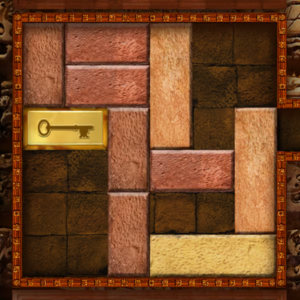
Free the Key is a digital iteration of the classic "sliding block" puzzle genre (often compared to Rush Hour or Unblock Me). From a cognitive science perspective, this game is a pure exercise in sequential planning within a constrained environment. The objective is to move a specific block (the Key) to the exit point. However, the path is obstructed by other blocks that operate under rigid movement rules.
The core difficulty lies in the directional constraints. Vertical blocks can only move up and down; horizontal blocks can only move left and right. This creates a dependency chain (or a "deadlock") where moving Block A requires moving Block B, which in turn requires moving Block C. The player must mentally traverse this dependency tree in reverse order to find the solution.
🧩 Algorithmic Thinking & Heuristics
Solving these puzzles engages the same neural pathways used in computer programming (specifically, the A* search algorithm):
- Look-Ahead Depth: Novice players move blocks randomly until a path opens. Expert players calculate the "Manhattan Distance"—visualizing the minimum number of moves required to clear a specific lane.
- Temporary Regression: Often, you must move the Key away from the exit to create the space needed to shuffle a larger obstacle out of the way. This counter-intuitive requirement tests the player's cognitive flexibility.
- Space Management: The grid is finite. The game is essentially a management of "empty space." The empty tile is your most valuable resource; you are not moving blocks, you are moving the void.
🎮 Level Progression
The game features a difficulty curve that introduces increasingly crowded grids:
- Early Levels: Focus on simple 1-2 step displacements.
- Advanced Levels: Require 20+ moves to clear a single path, demanding high working memory capacity to store the sequence of operations.
📱 Technical Optimization
Designed for touch interfaces, the 2025 build utilizes vector graphics to ensure crisp edges on high-DPI mobile screens. The input latency is minimized to allow for rapid block sliding without friction.
❓ FAQ
Is there only one solution?
While there is always an "optimal" solution (fewest moves), many puzzles can be solved through various less efficient sequences.
Why can't I move the block sideways?
The orientation of the block dictates its movement axis. Vertical blocks are strictly locked to the Y-axis.