Hextris
🛑 Hextris: Rotational Symmetry & Spatial Packing
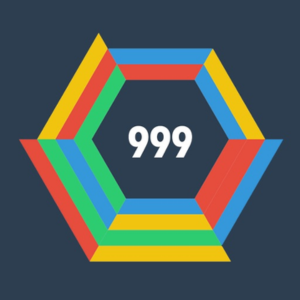
Hextris reinvents the falling-block genre by mapping it onto a Hexagonal Grid with radial gravity. Instead of blocks falling down a 2D well (as in Tetris), they collapse inward toward a central singularity. On Watch Documentaries Games, we classify this as a "Rotational Reflex Puzzle." The player controls the rotation of the central hexagon, effectively managing six simultaneous "wells."
The difficulty stems from the Multi-Directional Focus. In traditional puzzles, threats come from one direction (top). In Hextris, threats approach from six vectors simultaneously. The player must maintain 360-degree situational awareness, rotating the core to catch incoming colored bars on the matching face.
⚙️ Mechanics: Combo Multipliers
The scoring algorithm rewards speed and continuous matching:
- The Collapse: Matching 3 colors causes them to vanish, shrinking the stack. However, unlike Tetris, the stack is circular. Clearing a line on one side might destabilize the rhythm on the opposite side.
- Rotational Inertia: The controls (Left/Right Arrows) rotate the hexagon by 60-degree increments. Rapidly tapping the key allows for a 180-degree spin to catch a block on the opposite side. This requires high APM (Actions Per Minute).
- Speed Scaling: As the score increases, the velocity of incoming blocks accelerates. The "Time to Impact" shrinks, forcing the player to rely on peripheral vision to identify color matches.
🧠 Cognitive Load Analysis
Hextris forces the brain to process Color Recognition and Spatial Orientation in parallel. A common cognitive failure state occurs when the player focuses too hard on one sector (e.g., the top) and fails to notice a critical stack overflow in the bottom-left sector. Successful players constantly scan the perimeter in a clockwise or counter-clockwise loop.
🏆 Strategy: The Flat Top
Surface Area Management: The optimal strategy is to keep the stacks on all six sides relatively even. Creating a single high tower ("The Spire") is dangerous because it reduces the time you have to react to blocks coming from that specific angle. Flatter surfaces give you the maximum time window to rotate and match.
❓ FAQ
When does the game end?
Game Over occurs when any stack of blocks touches the outer grey border of the arena. It is a "sudden death" mechanic.
Can I slow down the blocks?
Only by clearing matches. Clearing a combo momentarily pauses the acceleration, buying you a few seconds of breathing room.