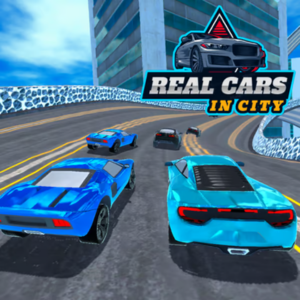
Real Cars In City
🏙️ Real Cars In City: Urban Sandbox and Stunt Physics
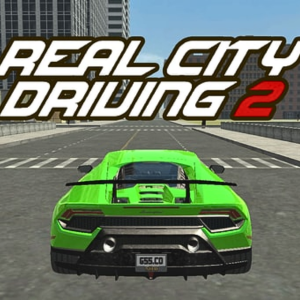
Real Cars In City represents the evolution of browser-based open-world simulations. Unlike linear racing games where the objective is merely to finish first, this title functions as a physics sandbox. It drops players into a large-scale urban environment populated with ramps, loops, and obstacles designed to test the limits of the vehicle's suspension and crash deformation systems. In the 2026 gaming landscape, it is praised for its "freeroam" philosophy, allowing players to create their own fun through emergent gameplay loops.
The game bridges the gap between arcade accessibility and simulation complexity. While the cars are easy to drive (Arcade handling), they react to the environment with semi-realistic rigid body dynamics. Hitting a ramp at an oblique angle causes the car to tumble, requiring mid-air correction to land safely.
🧠 Cognitive Skills: Spatial Navigation
Navigating an open city without a GPS marker trains specific spatial skills:
- Cognitive Mapping: Players essentially build a mental map of the city. Remembering that the "Super Loop" is near the docks or the "Drift Arena" is behind the skyscrapers trains spatial memory.
- Trajectory Calculation: Stunt driving is math. To clear a gap between two buildings, the player must estimate the required velocity and entry angle. This intuitive calculus is honed through trial and error.
- Resource Allocation: In modes involving currency (for car customization), players must decide between upgrading the engine (Speed) or the tires (Control). This cost-benefit analysis dictates their success in different stunt types.
🎮 Mechanics & Engineering Analysis
The engine features several distinct mechanical systems:
- Customization Engine: Players can modify body kits, spoilers, and rims. While aesthetic, these changes often affect the car's visual hitbox. More importantly, engine upgrades directly alter the torque curve, allowing for faster acceleration on short runways.
- Crash Deformation: Unlike older games with static health bars, this title features visual mesh deformation. Crashing into a wall crumples the hood. This visual feedback reinforces the sense of speed and consequence.
- Aerodynamics (Simulated): While simplified, spoilers and wings provide downforce. A car with a high-level wing will stick to the road better in high-speed corners than a stock vehicle.
🏆 Sandbox Strategy Guide
1. The "Air Control" Technique
The game allows for slight mid-air rotation. If you launch off a ramp and the car begins to nose-dive, hold the 'Down/Reverse' key to lift the nose. Landing on all four wheels is critical to maintaining momentum for the next jump.
2. Farming Credits
To unlock the high-end supercars quickly, focus on the "Stunt Zones." Completing specific jumps or collecting hidden coins in hard-to-reach places usually yields a higher payout per minute than aimless driving.
🛡️ Technical Specifications
Optimized for modern WebGL browsers:
- Draw Distance: The engine utilizes aggressive Level of Detail (LOD) scaling, allowing you to see distant skyscrapers without dropping frames on mid-range laptops.
- Lighting: Features dynamic reflections on the car body, enhancing the sense of realism.
❓ FAQ
Is there traffic?
Yes, the city features AI traffic. Avoiding (or crashing into) them is part of the challenge.
Can I play with a controller?
The game supports standard Gamepad inputs via the browser API, providing analog throttle control.