Stacktris
🧱 Stacktris: Rotational Inertia & Stability
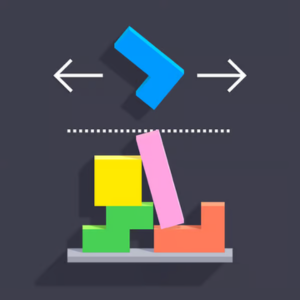
Stacktris reinvents the polyomino genre by adding a Z-axis and rotational inertia. Unlike Tetris, where blocks fall on a grid, here blocks spin rapidly on a central axis. The player must stop the spin at the precise millisecond to align the block with the tower's footprint. On Watch Documentaries Games, we classify this as a "Timing & Alignment" puzzle.
The core challenge is Center of Mass Management. The tower does not have a rigid grid; it relies on a physics engine. If you place a heavy T-block hanging off the edge, the entire tower's center of gravity shifts, potentially causing a catastrophic collapse.
⚙️ Mechanics: The Spin-Stop
The gameplay loop is a two-step verification process:
- The Spin: The block rotates. The speed increases with the tower height. The player clicks to stop the rotation.
- The Drop: Once stopped, the block falls. It interacts with the surface below. Uneven surfaces cause the block to slide or tumble.
🧠 Cognitive Skill: Visual Alignment
The brain must predict the orthogonal alignment. Stopping a block at a 45-degree angle is usually fatal, as it creates a slope that future blocks will slide off. The goal is to achieve 90-degree stops consistently to create flat platforms.
🏆 Optimization Strategy
The Pyramid Method: As the tower grows, it inevitably becomes unstable. The best strategy is to build a wide base (pyramid shape) whenever possible, rather than a single vertical column. Sacrificing height for width in the early game provides a stable foundation for the high-speed late game.
❓ FAQ
Can I rotate the block manually?
No. You can only stop the automatic rotation. This removes player agency and turns it into a reflex test.
What determines the score?
Score is based on the number of blocks stacked. Bonus multipliers are awarded for perfect alignment (snapping).