Bottle Flip
🔄 Bottle Flip: Mastering Angular Momentum
Bottle Flip strips away narrative to focus entirely on a single, complex mechanical interaction: rotational dynamics. Originating from a viral cultural trend, this digital adaptation transforms a party trick into a rigorous test of timing and estimation. It is a pure "skill check" simulation designed to frustrate and reward in equal measure based on the player's grasp of digital gravity.
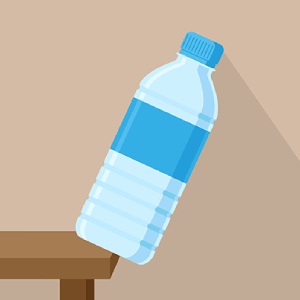
The game engine uses a simplified fluid dynamics model. The "water" inside the bottle shifts the center of mass during rotation, mimicking the real-world difficulty of landing a partially filled container upright. This shifting weight distribution is the core variable players must master.
🧠 Skill Acquisition: The Loop of Mastery
Why is this simple action so engaging for the human brain?
- Dopamine Feedback Loops: The binary outcome (success/fail) provides immediate feedback, encouraging "just one more try" behavior which solidifies muscle memory.
- Pattern Recognition: Players unconsciously learn the exact duration of a mouse press required to generate specific torque values.
- Focus & Flow: The repetitive nature induces a flow state, where external distractions fade away as the brain focuses solely on the physics arc.
🎮 Engine Mechanics & Control Theory
Success in Bottle Flip is determined by two main factors programmed into the logic:
- Force Vector (The Hold): The duration you hold the input determines the vertical thrust. Too little, and it won't clear the distance. Too much, and it overshoots.
- Torque (The Spin): The release point dictates the rotation speed. The bottle must complete exactly one (or two) full rotations (360° or 720°) to land flat. Landing at an angle > 15° usually results in a fail state due to the friction simulation.
- Surface Variation: You aren't just flipping onto tables. Shelves, moving platforms, and sliding objects introduce new friction coefficients and target windows.
🏆 Optimization Strategies
1. The Double-Flip Risk
While a single flip is safer, the game rewards risk. However, the angular velocity required for a double flip drastically reduces the margin for error on landing. Only attempt this on wide, flat surfaces like the grand piano or the long table.
2. Platform Leading
When dealing with moving platforms (e.g., the sliding shelf), you must lead your shot. Treat the bottle as a projectile and the platform as an intercept course. Release when the platform is roughly 0.5 seconds away from the landing zone.
🛡️ Safety & Performance
This title is fully HTML5 compliant and requires no Flash player:
- Zero-Asset Load: The minimalist art style means near-instant rendering on Chromebooks and mobile browsers.
- Ad-Free Gameplay Flow: Designed to minimize interruption between attempts to maintain the player's cognitive rhythm.
❓ FAQ
Why does the bottle fall over even if it lands flat?
This simulates the center of gravity. If the bottle has too much horizontal momentum upon landing, inertia will tip it over despite a flat contact.
Can I play on mobile?
Yes, the input is mapped to touch duration. In fact, many users find haptic feedback on mobile screens offers better precision than a mouse click.