Breaking the Bank
🧩 Breaking the Bank: A Study in Non-Linear Narrative Design
Breaking the Bank serves as a pivotal historical artifact in browser gaming history, marking the debut of the now-legendary Henry Stickmin collection. Unlike traditional linear adventures, this title operates as an interactive decision tree. It is not merely about success; it is a catalog of comedic failures, encouraging players to explore every incorrect variable before finding the solution.
In the context of 2025's gaming landscape, this title remains relevant as a masterclass in minimalist storytelling and animation timing. The game eschews complex controls for a pure point-and-click interface, testing the player's causal reasoning. Each choice represents a distinct narrative branch, making it excellent material for analyzing determinism in gameplay loops.
🧠 Cognitive Mechanics: The Value of Failure
While seemingly simple, the game engages specific cognitive processes:
- Deductive Reasoning: Players must analyze the environment (the bank wall) and hypothesize which tool (explosives, shovel, teleporter, etc.) interacts logically with the physics of the world.
- Pattern Recognition: The game often subverts expectations using "cartoon physics." Learning to anticipate the absurdity is key to understanding the developer's logic.
- Memory Retention: Success requires memorizing previous failed attempts to eliminate variables, a fundamental aspect of the scientific method applied to gaming.
🎮 Gameplay Analysis & Decision Vectors
The core loop involves selecting one of six primary options to breach the bank vault. Each option triggers a unique animation sequence rooted in Flash-era aesthetics, now fully rendered via HTML5/Canvas for modern browsers.
The Interaction Palette:
- The Shovel: Simulates manual labor but introduces environmental hazards (gas lines).
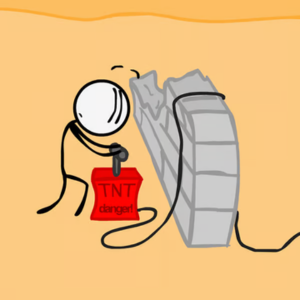
- The Explosives: Tests the game's collision physics and blast radius logic (often resulting in self-termination).
- The Teleporter: A sci-fi variable that introduces randomization and coordinate errors.
- The Laser: High-tech cutting mechanics that interplay with reflection dynamics.
- Wrecking Ball: Momentum and gravity simulation.
- Disguise: Social engineering attempt within the game's AI logic.
🏆 Strategy: Achieving the "Rank" Ending
There is only one successful outcome among the failures. To achieve the specific ending required for progression, players must look for the option that utilizes the environment's unpredictability rather than brute force. Pro Tip: Pay attention to the police cruiser's patrol loop patterns in the background animation; they are not just cosmetic but indicators of timing.
💻 Technical Specifications
This version has been recompiled from the original SWF specifically for low-latency performance on:
- Chromebooks (ARM & x86): Optimized vector graphics ensure zero lag on school hardware.
- Touch Devices: The hitboxes have been expanded for precise input on tablets and mobile screens.
❓ FAQ
Is Flash Player required in 2026?
No. This version utilizes Ruffle emulation and native HTML5 canvas rendering, making it secure and plugin-free.
How many endings are there?
Technically, there is 1 successful ending and 5 unique fail states. A true completionist watches all 6 outcomes.