2048 Multitask
🔀 The Myth of Multitasking: Cognitive Load Test
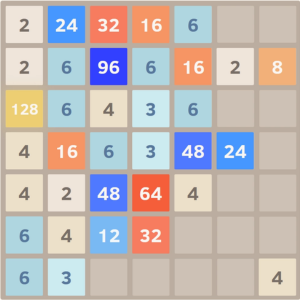
2048 Multitask takes the sliding-tile logic of the original 2048 and duplicates it across split screens. The player must manage two (or more) independent grids simultaneously. The input, however, is shared or toggled. This gameplay serves as a simulation of Divided Attention. Neuroscientifically, humans do not truly multitask; we rapid-switch (context switch). This game penalizes the "Switch Cost"—the mental lag that occurs when refocusing from Board A to Board B.
The core challenge is not the math (powers of 2), but the entropy management. Leaving one board unattended while fixing the other usually results in the neglected board filling up with "garbage" tiles, leading to a Game Over.
🧠 Executive Function Training
This game strains the prefrontal cortex:
- Inhibitory Control: You might see a perfect move on the left board, but making it might ruin the setup on the right board (if inputs are linked). You must inhibit the impulse to act on one signal to protect the whole system.
- Visual Scanning: The eyes must constantly saccade (jump) between two focal points. This trains rapid visual information processing.
🎮 Mechanics: Linked vs. Split Inputs
Depending on the mode:
- Shared Input: Pressing Up moves tiles up on BOTH boards. This is a synchronization puzzle. You must find a move that is beneficial (or at least neutral) for both states.
- Independent Fate: If one board fills up, the game ends. You are only as strong as your weakest link.
- Look-Ahead: The standard 2048 strategy (keep the highest number in the corner) becomes twice as hard to maintain when external inputs disrupt the pattern.
🏆 Survival Strategies
1. The "Master" and "Slave" Board
Mentally designate one board as the "Master" (the one with the better run) and the other as "Slave." Focus 70% of your attention on the Master board to ensure a high score, but ensure the Slave board makes "safe" moves (down/right) to stay alive without optimizing it.
2. Syncing Corners
Try to keep the high-value tiles in the same corner on both boards (e.g., bottom-right). This allows you to use the same safe inputs (Down and Right) to manage both grids effectively. If one board has the high tile in the top-left and the other in the bottom-right, you are doomed.
🛡️ Technical Performance
Optimized for focus:
- UI Layout: The boards are positioned to fit within the central foveal vision range on standard monitors, minimizing head movement.
- Input Buffering: Prevents missed keystrokes during rapid toggling.
❓ FAQ
Is it actually possible?
Yes, but it requires abandoning the goal of a "perfect" game on both boards. Survival is the priority.
How are new tiles spawned?
Tiles (2 or 4) spawn in empty spaces. With two boards, the probability of a bad spawn doubles.