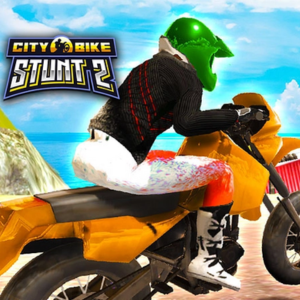
City Bike Stunt 2
🏍️ City Bike Stunt 2: A Study in Aerodynamics and Momentum
City Bike Stunt 2 is not merely a racing game; it is a physics-based challenge regarding center-of-mass management. Unlike car simulations where stability is provided by four points of contact, this title requires the player to actively manage the pitch and yaw of a motorcycle while airborne. At Watch Documentaries Games, we recommend this title for training reaction times and fine motor control.
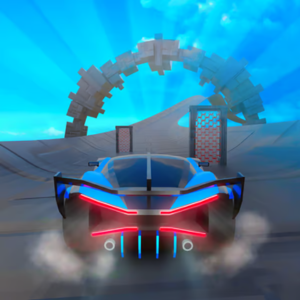
The game features a futuristic, hyper-elevated track design. This verticality introduces a fear of falling (acrophobia simulation), which heightens player focus and adrenaline response, sharpening reflex loops during gameplay.
🧪 The Science of the Stunt
To succeed in City Bike Stunt 2, players must intuitively understand several physical concepts:
- Angular Momentum: When airborne, the bike rotates around its center. Holding 'Forward' or 'Back' alters this rotation. Landing with the wheels parallel to the slope is critical to prevent the "ragdoll" fail state.
- Nitrous Oxide (N2O) Dynamics: The nitro boost doesn't just add speed; it alters the vehicle's trajectory. Activating nitro on a ramp increases jump distance exponentially. Players must calculate if the boost will overshoot the landing zone.
- Friction Coefficients: The game differentiates between asphalt (high grip) and metal ramps (lower grip), affecting braking distances.
👥 Split-Screen & Competitive Latency
One of the standout features is the local 2-Player mode. Technically, this renders two viewports simultaneously on the same canvas. This is an excellent stress test for browser performance and offers a social gaming element that is rare in web-based titles.
- Player 1: Uses Arrow Keys for navigation and N for Nitro.
- Player 2: Uses WASD for navigation and T for Nitro.
Playing in split-screen demands higher cognitive processing, as the player must filter out visual noise from the opponent's screen half while focusing entirely on their own quadrant.
🎮 Modes of Operation
The simulation offers two distinct testing environments:
- Racing Mode: A time-trial based challenge where efficiency and the "racing line" are paramount. The goal is to minimize distance traveled by hugging corners.
- Free Riding Mode: A sandbox environment for testing physics without time constraints. This is ideal for practicing ramp approaches and mid-air stabilization techniques.
🏆 Mastery Techniques
The Mid-Air Correction
A common mistake is freezing when the bike leaves the ground. Professional players use airtime to adjust the bike's pitch. If the landing ramp is steep, lean forward. If flat, land on the rear wheel to absorb impact. This constant micro-adjustment distinguishes skilled operators from novices.
❓ FAQ
Why does the bike crash on landing?
You likely landed with too much perpendicular force. You must align your wheels with the angle of the ground to convert downward momentum into forward velocity.
Is 2-Player mode laggy?
On modern devices, the game runs at 60 FPS. Older hardware may experience frame drops due to rendering two cameras simultaneously.