Drive Mad
🚛 Drive Mad: The Wheelbase Dynamics Puzzle
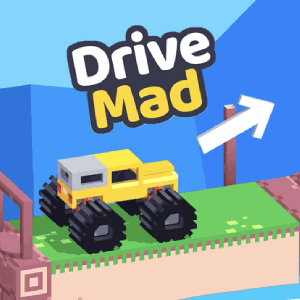
Drive Mad disguises itself as a monster truck game, but it is fundamentally a physics puzzle regarding center of gravity and torque. Each level presents a unique vehicle configuration—some are long and flexible, others are tall and top-heavy, some have square wheels. On Watch Documentaries Games, we analyze this as a challenge of "Adaptive Control."
The core conflict is between the power of the engine and the stability of the chassis. The trucks have high torque, meaning sudden acceleration often results in a wheelie and a flip (failure state). Success requires delicate throttle management.
🧩 Level Design & Vehicle Logic
The puzzle element comes from understanding the specific limitations of the level's vehicle:
- The Limousine: Long wheelbase. It bridges gaps easily but bottoms out on sharp peaks ("high-centering").
- The Square Wheels: These create a violent vibration. You must time your acceleration to sync with the flat sides of the wheels to gain traction.
- The Joined Truck: Two trucks connected by a loose hitch. You must manage the momentum of two independent bodies; if the front truck stops, the rear truck creates a jackknife collision.
🎮 Control Precision
The input is binary but demands analog sensitivity via tapping:
- Forward: W, D, Right Arrow.
- Reverse/Brake: S, A, Left Arrow.
Tip: Air control is vital. When airborne, pressing 'Forward' tilts the nose up; 'Reverse' tilts the nose down. Use this to land on all four wheels.
🏆 Strategy: The Soft Landing
Speed is often a trap. Many levels feature fragile bridges or water traps that punish aggressive driving. The "Crawl Strategy"—moving as slowly as possible without losing momentum—is often the only way to clear levels with uneven terrain or dynamic obstacles that break upon impact.
❓ FAQ
Why does my truck explode instantly?
The driver's cabin has a fragile hitbox. If the roof touches the ground or a wall, the level resets immediately to enforce safety physics.
How do I pass the water levels?
Momentum. Do not stop in the water. The fluid dynamics create drag; if you lose speed, your tires will spin helplessly.