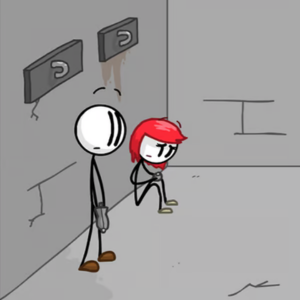
Fleeing the Complex
🏃 Fleeing the Complex: A Branching Narrative Experiment
Fleeing the Complex stands as a definitive entry in the interactive fiction genre, popularized by the Henry Stickmin collection. It is not merely a game of "click the right button," but a satirical exploration of pop culture tropes and logical fallacies. Set in a high-security facility known as "The Wall," the game tasks players with navigating a complex decision tree where logic often takes a backseat to chaotic humor.
From a design perspective, this title is an excellent case study for "Choose Your Own Adventure" (CYOA) mechanics adapted for the digital age. It utilizes Quick Time Events (QTEs) and timed decision points to maintain pacing, ensuring the player remains an active participant in the unfolding animation.
🗺️ The Map of Chaos: Decision Trees & Endings
The replay value lies in its divergent pathways. The game code tracks state variables to deliver five distinct canon endings, ranked by community prestige:
- Ghost Inmate (GI): The stealth route. Requires patience and refusing to engage in combat. This is statistically the hardest ending to achieve due to strict timing windows.
- Presumed Dead (PD): A tragic yet strategic ending where the protagonist fakes their demise to escape the loop.
- International Rescue Operative (IRO): The "action movie" route involving heavy weaponry and external assistance.
- The Betrayed (TB): A narrative twist that explores the consequences of trusting the wrong NPC (Non-Playable Character).
- Convict Allies (CA): The cooperative route, emphasizing teamwork mechanics.
⏱️ Mechanics: QTEs and Map Logic
While the interface is simple (point-and-click), the underlying logic tests several player attributes:
- Reaction Time: Certain sequences (especially in the IRO route) require inputs within 500ms.
- Trial and Error Learning: The game encourages failure. Each "Fail" screen provides a unique, often humorous text snippet or cultural reference, turning the "Game Over" state into a reward mechanism rather than a punishment.
- Reference Recognition: Puzzles often rely on knowledge of video game physics or movie logic (e.g., using a Gravity Gun vs. a simple lockpick).
🎭 Cultural Significance & Humor
The game serves as a time capsule of internet culture. It integrates references to Pokemon, Mario, and classic action cinema. For modern players, it acts as an interactive museum of flash-era creativity, preserved now through HTML5 emulation technologies ensuring it runs on mobile and desktop without plugins.
🛡️ Accessibility & Performance
This version is the remaster of the original Flash file:
- Vector Graphics: The stick-figure art style scales infinitely without pixelation, looking crisp on 4K monitors.
- Touch Support: Fully optimized for tablets and touchscreens, replacing mouse clicks with intuitive taps.
❓ FAQ
How many fails are there?
There are exactly 60 unique fail animations. Finding them all is considered a "completionist" run.
Is Ellie in this game?
Yes, this is the title that introduces Ellie Rose, a key character who assists (or hinders) Henry depending on your choices.