Two Button Bounce
🧩 Two Button Bounce: A Study in Ambidextrous Coordination
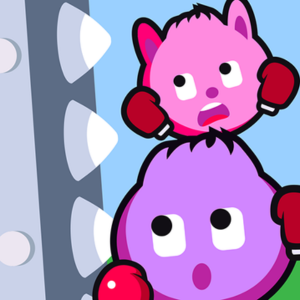
Two Button Bounce strips the platformer genre down to its barest mechanical essentials: gravity, momentum, and binary input. Unlike traditional games that rely on complex control schemes, this title challenges the player's corpus callosum—the part of the brain responsible for communication between the left and right hemispheres. You control two distinct bouncing avatars simultaneously, turning a simple puzzle into a rigorous test of cognitive synchronization.
The game operates on a strictly deterministic physics engine. There is no randomness; every failure is a result of input timing or trajectory miscalculation. This makes it an ideal environment for players who enjoy "programming" their movements rather than reacting to chaotic RNG (Random Number Generation). The minimalist vector graphics ensure that the visual cortex is not overwhelmed, allowing total focus on spatial logic.
🧠 Cognitive Load & Spatial Reasoning
Engaging with this dual-control mechanic offers specific mental exercises:
- Bilateral Integration: Pressing the Left and Right arrows independently to control two separate entities trains the brain to decouple hand movements.
- Trajectory Prediction: Players must mentally simulate the parabolic arc of the bounce before executing the move, enhancing spatial visualization skills.
- Error Analysis: The instant respawn mechanic creates a rapid feedback loop, allowing for iterative hypothesis testing on how to clear a level.
🎮 Mechanics & Physics Analysis
The engine uses a simplified collision detection system that prioritizes edge-perfect interactions. Key features include:
- Constant Vertical Velocity: Unlike standard platformers, your characters are in a state of perpetual bouncing. You do not control the jump height, only the lateral movement. This constraint forces players to use the environment (walls, platforms) to modulate their position.
- Interactive Geometry: Not all surfaces are static. Moving platforms and laser gates operate on global timers. Success often requires synchronizing your bouncing rhythm (internal clock) with the level's cycle (external clock).
- Input Latency: The game is optimized for < 16ms input delay, essential for the later levels where "frame-perfect" movements are required to avoid hazards.
🏆 Strategic Walkthrough
1. The "Staggered Bounce" Technique
In levels where both characters face identical hazards but at different intervals, do not press both buttons simultaneously. Intentionally desynchronize the characters so one hits the floor while the other is at the apex of their jump. This staggering allows you to monitor them individually rather than trying to process two identical movements at once.
2. Wall Friction Utilization
Pushing against a vertical wall does not stop your vertical momentum, but it aligns your horizontal position perfectly. Use walls as "reset points" to align your characters before making a dangerous crossing over a spike pit.
🛡️ Technical Specs & Accessibility
Designed for universal access across educational and home networks:
- Rendering: Canvas API 2D, ensuring compatibility with legacy GPUs and integrated graphics cards.
- Data Usage: extremely low bandwidth requirement (< 2MB initial load), making it playable on throttled connections.
❓ FAQ
Is this multiplayer?
No, it is a single-player puzzle designed to test one person's ability to control two objects. However, it can be played locally in "co-op" mode by having two people share one keyboard (one takes Left, one takes Right).
Why do I keep hitting the spikes?
The hitboxes are precise. You are likely misjudging the width of the avatar. Assume the character is 10% wider than the visual sprite to play safely.