Fnf B Sides
🎵 Fnf B Sides: Disrupting Muscle Memory through Remix Culture
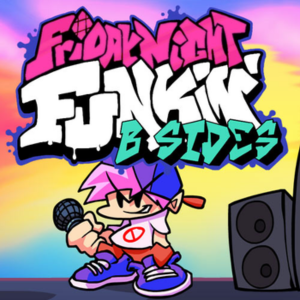
Fnf B Sides is not merely a visual reskin; it is a fundamental re-engineering of the auditory-motor synchronization loop. In the standard Friday Night Funkin' meta, players often rely on rote memorization of charts. B Sides, available on Watch Documentaries Games, deliberately breaks these neural pathways by altering the instrumental tracks and note timings (BPM variance), forcing players to re-learn the rhythm from scratch.
This modification serves as a case study in neuroplasticity. By retaining the familiar visual cues of the original levels but drastically shifting the audio cues, the game creates a "cognitive dissonance" that the player must overcome through rapid adaptation. It effectively simulates the difference between playing sheet music sight-unseen vs. playing a known piece with a new tempo.
🧠 Cognitive Demands: Syncopation & Off-Beat Processing
The remixing technique introduces complex musical theory concepts:
- Syncopation: Unlike the "on-beat" focus of the original, B-Sides places heavy emphasis on the off-beat (the "and" of the count). This requires a higher level of rhythmic subdivision in the player's mind.
- Color Association Override: The mod shifts the color palette. Players who rely on peripheral color recognition for arrows must adjust to the new, higher-contrast neon aesthetic, retraining their visual cortex.
🎮 Mechanics: The Remix Engine
The technical changes extend to the input window:
- Input Tolerance: While the engine is Kade Engine-based (usually), the charting often utilizes "staircase" patterns that are chemically faster than the original engine allowed.
- Endurance: The remixed tracks are often longer and feature more sustained "holds," testing finger stamina alongside reaction time.
🏆 Mastery: Re-learning the Groove
1. Listen, Don't Look
Because the charts are visually dense, relying solely on eyes leads to sensory overload. Pro players shift focus to the bassline. The B-Side remixes often tie the player's input to the bass/drums rather than the melody. Sync your fingers to the percussion.
2. The Double-Tap Method
For the faster "trill" sections introduced in Week 4 B-Side, utilize two fingers per key (if using a specialized setup) or master the alternating hand technique to maintain high BPM without fatigue.
❓ FAQ
Is it harder than Whitty?
It focuses on different skills: Whitty is speed; B-Sides is rhythmic complexity.
Why do the notes look different?
The assets are recolored to signal that this is an alternate dimension/timeline.