Moto Road Rash 3D
🏍️ Moto Road Rash 3D: Risk Analysis in High-Density Traffic
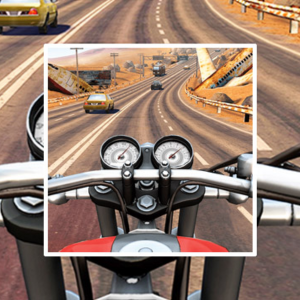
Moto Road Rash 3D is a kinetic study of risk management. Unlike track racers where the optimal line is static, here the environment is a chaotic variable. Hosted on Watch Documentaries Games, this title simulates the adrenaline-fueled dynamics of illegal lane-splitting, requiring the player to constantly calculate the "Time to Collision" (TTC) against the potential score reward.
The game runs on a robust 3D engine capable of rendering multiple AI traffic agents simultaneously. Each car on the road has a randomized behavior pattern (lane changes, sudden braking), turning the highway into a procedural obstacle course that tests reaction times down to the millisecond.
🧠 Cognitive Load: Tunnel Vision & Peripheral Processing
Success in this simulation depends on managing visual data overload:
- Flow State Induction: As speed increases (exceeding 100 km/h), the Field of View (FOV) effectively narrows. Players must train their peripheral vision to detect blinkers or wheel movements of cars three rows ahead.
- Risk/Reward Calculation: The "Near Miss" mechanic incentivizes dangerous proximity. The brain must constantly weigh the dopamine hit of a bonus score against the catastrophic failure state of a crash.
🎮 Mechanics: Career Progression
The metagame involves a detailed economic simulation:
- Power-to-Weight Ratio: Upgrading the engine increases top speed, but without upgrading handling (tires/brakes), the bike becomes uncontrollable. Balancing these stats is key to long-term survival.
- Game Modes: From "Time Trial" (pure efficiency) to "Endless" (endurance), each mode requires a different mental approach. In Career mode, specific objectives (e.g., "Overtake 50 cars") force aggressive playstyles.
🏆 Pro Strategies: The White Line Theory
1. Lane Splitting Efficiency
The safest place is paradoxically the most dangerous: the white line between lanes. AI cars are programmed to stay in lanes, meaning the space between them is statistically the most stable, provided you can maintain a straight vector.
2. Brake Check Management
Never hold the throttle at 100% constantly. Use a "pulse and glide" technique. Release the throttle for a fraction of a second when approaching a cluster of cars to assess the gap, then accelerate through. Braking kills momentum; coasting preserves it.
❓ FAQ
Does it support wheel controllers?
The input is optimized for Keyboard (WASD/Arrows), providing digital precision for rapid lane changes.
How to do a wheelie?
Depending on the bike stats, rapid acceleration from a standstill or specific key combos can trigger front-wheel lift.