Shape Fold
🧩 Shape Fold: Introduction to Kinematic Linkages and Topology
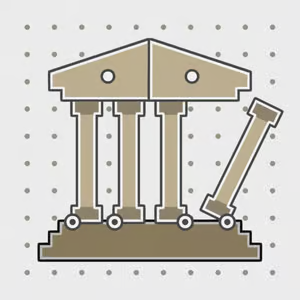
Shape Fold is a standout title in the "relaxing puzzle" genre that secretly serves as an introduction to mechanical engineering principles. Unlike traditional jigsaws where pieces are free-floating, Shape Fold uses the concept of kinematic linkages. Every piece is physically connected to another via a hinge (pivot point). You cannot move a piece in isolation; moving one segment exerts torque and translation on its neighbors. The goal is to fold these chains of rigid bodies until they fit perfectly into a white silhouette.
In the 2026 gaming market, this title is praised for its tactile feel. It simulates the physical resistance and constraint of real-world objects, providing a satisfying "snap" when a structure is correctly folded. It strips away score counters and timers to focus purely on topological logic.
🧠 Educational Value: Spatial Manipulation
This game is a powerful tool for developing the parietal lobe's spatial processing capabilities:
- Hierarchical Logic: Players must identify the "root" of the structure. You cannot fold the outer layers until the inner layers are positioned correctly. This trains the brain to recognize Order of Operations.
- Rotational Geometry: The puzzles require mentally rotating shapes. A piece might look like it fits, but if it is attached to a hinge on its left side, it can only swing in an arc. Players learn to visualize these radial paths.
- Depth Perception (Z-Axis): Although 2D, the game simulates layers. Pieces can fold over or under each other. Figuring out which piece must be on the bottom layer to avoid blocking a top-layer slot is a rigorous depth-sorting task.
🎮 Mechanics & Physics Simulation
The engine utilizes a custom Inverse Kinematics (IK) solver suited for puzzles:
- The Hinge System: The core variable. Some hinges allow 360-degree rotation, while others might be limited (though usually free in this version). The distance between hinges is fixed (rigid body constraint), meaning the challenge is purely rotational.
- The Drag Interaction: Players interact by clicking and dragging a piece. The physics engine calculates how the rest of the connected chain should react. This mimics the feel of unfolding a paper map or a complex mechanical arm.
- The "Snap" Mechanic: A critical accessibility feature. When a piece is near its correct final vector and position, it locks into place. This reduces frustration and confirms partial solutions, allowing players to solve the puzzle incrementally.
🏆 Solving Strategy & Methodology
1. The Anchor Point Technique
Every level has a "root"—a piece that matches a distinct part of the silhouette and usually has the most connections. Identify this anchor first. Do not start with the dangling ends of the chain; they are too volatile. Place the anchor to stabilize the board, then fold the limbs relative to that fixed point.
2. The "Explosion" Method
When the level starts, the pieces are often crumpled in a confusing pile. The best first move is to drag everything outwards, expanding the shape as far as the linkages allow. Seeing the structure "flat" reveals the topology and makes it obvious which chain belongs to which part of the silhouette.
3. Layering Check
If a piece is in the right spot but isn't "snapping" (turning solid color), it is likely blocked by a collision. You probably have another piece underneath it that shouldn't be there. Pull the top piece away and check the layer underneath.
🛡️ Technical Specifications
A lightweight, universal application:
- Graphics: Uses vector-based rendering, ensuring crisp lines on everything from low-res school projectors to 4K monitors.
- Input: Extremely high accessibility. The entire game can be played with a single finger (touch) or one mouse button. No keyboard or complex gestures required.
❓ FAQ
Is there a specific order to fold?
Yes. Just like packing a box, you must place the bottom items first. If you fold the top layer first, it physically blocks the bottom layer from entering its slot.
Are the puzzles random?
No, each level is a handcrafted topology puzzle designed to test a specific folding concept.