Slope
📉 The Physics of Terminal Velocity
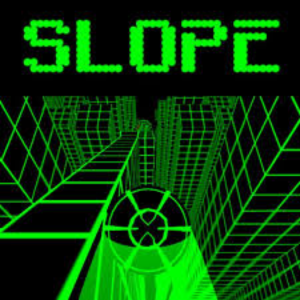
Slope is the archetype of the 3D physics runner. Built on the Unity engine, it simulates a sphere rolling down an infinite decline. The core mechanic is the interaction between Gravity, Friction, and Lateral Velocity. Unlike other runners with fixed lanes, Slope offers analog control. The ball has inertia; it resists changing direction. Moving left requires overcoming the forward momentum vector, resulting in a curved trajectory rather than a sharp turn.
The speed curve is aggressive. The game does not cap terminal velocity in the same way arcade racers do. The longer you survive, the faster the render loop runs, eventually testing the limits of human reaction time (< 150ms).
🧠 Visual Cortex Overload
The green-on-black aesthetic serves a cognitive function:
- High Contrast Tracking: The wireframe aesthetic reduces visual noise, allowing the occipital lobe to focus entirely on geometry processing.
- Tunnel Vision: As speed increases, the player's effective field of view narrows. Survival depends on shifting focus from the ball to the horizon line (look-ahead) to anticipate turns before they render fully.
🎮 Mechanics: The Red Zone
Collision rules:
- Touching Red: The red obstacles are "Kill Volumes." Even grazing a pixel results in shattering.
- Falling Off: Gravity is constant. If you leave the track, you fall. However, high-level players can sometimes "skip" corners by jumping off the track and landing on a lower section, utilizing the fall gravity to their advantage.
🏆 Survival Strategy
1. Stay Middle-ish
Do not hug the walls. The procedural generation often spawns obstacles on the edges. The geometric center of the platform offers the most options for evasion (Left or Right).
2. Micro-Movements
At high speeds, a full key press will send you flying off the edge. Use rapid, microscopic taps to adjust your trajectory. Think of it as vibrating the key rather than pressing it.
🛡️ Engine Specs
Tech details:
- WebGL Optimization: The game is highly optimized for low-end hardware, using simple shaders to maintain 60FPS, which is mandatory for the physics calculations to remain fair.
❓ FAQ
Is the track the same every time?
No, the course is procedurally generated. Every run is a unique seed.
Does the ball get heavier?
No, but the increased speed makes the momentum feel heavier due to the increased time required to stop lateral movement.