Two Neon Boxes
🔲 Two Neon Boxes: Hemispheric Synchronization and Multitasking
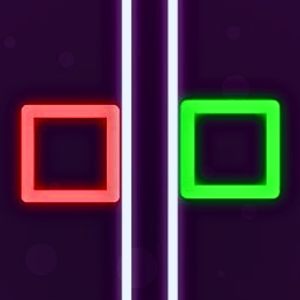
Two Neon Boxes is a minimalist puzzle-runner that serves as a direct test of divided attention and hemispheric synchronization. The premise is deceptively simple: tap left to move the left box, tap right to move the right box. However, the game forces the player to manage two independent data streams simultaneously. The left lane might require a slow rhythm while the right lane demands rapid dodging. The brain must decouple the hands to succeed.
In the cognitive gaming space of 2026, this title is used to train parallel processing. It challenges the brain's bottleneck for attention, forcing the player to switch focus rapidly (micro-tasking) or widen their gaze to process both lanes as a single visual gestalt.
🧠 Cognitive & Motor Skills
The game pushes executive functions to the limit:
- Divided Attention: Maintaining performance on Task A (Left Box) while simultaneously performing Task B (Right Box) is the definition of multitasking. Most players fail when the rhythms desynchronize.
- Inhibition: When the left box hits a wall, the instinct is to stop both hands. Players must inhibit the right hand's reaction to the left hand's stimuli.
- Peripheral Vision: You cannot look at one box. You must stare at the center line and use peripheral vision to track obstacles. This "soft focus" technique is essential for high scores.
🎮 Mechanics & Systems
The engine relies on strict binary inputs:
- Lane Logic: Each box has only two positions (Lane 1 / Lane 2). The input is a toggle. This binary simplicity removes mechanical error, leaving only cognitive error.
- Speed Ramping: The game speeds up linearly. The time-to-react decreases, eventually surpassing human reaction time if the player is scanning sequentially rather than parallelly.
- Pattern Divergence: Early levels mirror the obstacles (Left matches Right). Advanced levels decouple them, creating cognitive dissonance (Left needs to dodge, Right needs to collect).
🏆 Synchronization Strategy
1. The Anchor Eye
Do not look at the boxes. Look at the top 1/3rd of the screen where the obstacles spawn. By the time the obstacles reach the bottom, your hands should have already reacted. React to the spawn, not the collision.
2. Verbal Rhythm
If you are struggling, say the inputs out loud (e.g., "Left, Both, Right, None"). Vocalizing helps bridge the gap between visual processing and motor output during complex sequences.
🛡️ Technical Info
Neon minimalist aesthetic:
- Visuals: High contrast Neon on Black. This reduces visual noise, allowing the brain to process the geometric shapes efficiently.
- Input: Supports Mouse (Left Click / Right Click) or Keyboard (Left Arrow / Right Arrow). Keyboard is recommended for tactile feedback.
❓ FAQ
Is it 2 Player?
It can be! One player takes the Left box, the other takes the Right. This turns it into a co-op communication game.
Does it end?
It is an endless runner. The goal is a high score based on time survived.