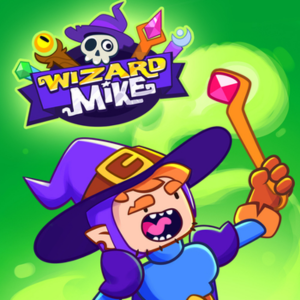
Wizard Mike
🧙♂️ Wizard Mike: Applied Geometry and Reflection
Wizard Mike disguises a rigorous physics puzzle as a casual adventure game. While the aesthetics are cartoonish, the underlying engine is a precise simulation of Trajectory Calculation and Reflection Logic. The player controls a wizard who casts spells that behave not like magic missiles, but like billiard balls. They obey the laws of reflection: the angle of incidence equals the angle of reflection. The objective is to eliminate all targets in a level using a limited number of casts, requiring the player to visualize complex bounce paths before firing.
🎱 The Billiard Physics of Magic
The core gameplay loop is a deconstruction of the "aim and shoot" mechanic found in games like Angry Birds, but applied to a confined "kill-room" scenario. The challenge is rarely direct combat; usually, the target is shielded behind an impenetrable wall or locked in a cage.
- Reflection Strategy: The player must use the edges of the screen and environmental obstacles to bank shots. A spell might need to bounce off the ceiling, hit the floor, and strike the enemy from below. This requires an intuitive understanding of geometry.
- Projectile Lifespan: Spells do not last forever. They have a limited number of bounces or a set "lifespan" before they fizzle out. This prevents the player from simply firing randomly and hoping for a lucky bounce. Every shot must be calculated.
⚡ Environmental Interaction & Chain Reactions
Wizard Mike excels in its use of "Rube Goldberg" style interactions. The most efficient solution is often to trigger a chain reaction rather than hitting the enemy directly:
- Physical Objects: Cutting a rope to drop a boulder, or knocking over a domino chain of stone pillars. These heavy objects deal lethal damage to enemies.
- Explosives: Hitting a TNT crate sends shrapnel or shockwaves that can push enemies into spikes or off ledges.
- Portals: Wormholes introduce non-linear topology. A spell entering a blue portal on the left might exit a blue portal on the right, maintaining its velocity vector. This adds a layer of spatial complexity.
🌌 Variable Gravity and Spells
As progression continues, the game introduces variables that alter the physics engine. Some levels feature low gravity, causing objects to float. Others introduce different spell types: some arc heavily (requiring parabolic aiming like a mortar), while others fly in a straight line (laser precision). Adapting to the specific weight and drag of the current spell is key to solving the puzzle.
🧠 Cognitive Benefits
This game serves as excellent training for Visuospatial Sketchpad functions—the part of working memory that handles visual and spatial information. The player must mentally simulate the path of the projectile, predicting 3 or 4 bounces into the future, which is a significant cognitive exercise.
❓ FAQ
Why did my spell pass through the enemy?
Some enemies have shields or armor. You must hit them from the exposed side (usually the back or bottom) to register a kill.
How do I unlock new outfits?
Completing levels with a 3-star rating earns you currency. You can use this in the main menu shop to buy cosmetic robes and hats.
Is the laser sight accurate?
The dotted aim line shows the initial trajectory, but it is short. You must mentally extend the line to predict where it will go after the first bounce.