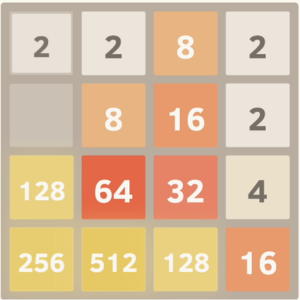
2048
🔢 The Mathematics of Spatial Entropy
2048 is more than a casual puzzle; it is a graphical representation of binary exponential growth confined within a finite topological space (a 4x4 matrix). The game demonstrates the concept of entropy: as the grid fills with low-value tiles (2s and 4s), the "disorder" increases, reducing the available moves. The player's goal is to organize this chaos by merging identical values ($2^n + 2^n = 2^{n+1}$) to liberate grid space.
Mechanically, it is a deterministic system with a stochastic element (the random spawn of new tiles). This combination requires the player to adopt a "Greedy Algorithm" approach—making locally optimal moves that preserve long-term stability.
🧠 Cognitive Algorithms: The Corner Heuristic
Success relies on imposing order through specific mental models:
- Monotonicity: The most effective strategy involves keeping the values in a strictly increasing or decreasing order along a serpentine path. This ensures that adjacent tiles are always compatible for merging.
- Inhibitory Control: The player must strictly inhibit the urge to press one direction (usually "Up"). Locking one direction simplifies the vector space, effectively turning the 2D grid into a more manageable 1D flow.
🎮 Mechanics: Zero-Sum Space
Every move has a cost:
- Spawn Logic: Every turn, a new tile (90% chance of a '2', 10% chance of a '4') spawns in an empty cell. If no empty cells remain and no merges are possible, the game terminates (Gridlock).
- Cascade Merges: Understanding that collapsing a row of [2, 2, 4, 8] results in [4, 4, 8, _] and eventually [16, _, _, _] is key to clearing rows instantly.
🏆 Mastery Strategy: The Anchor
1. The Immovable Object
Pick a corner (e.g., Bottom-Right). Keep your highest value tile there at all times. Never make a move that shifts this tile out of the corner. This "Anchor" acts as the gravity well for your entire numerical chain.
2. The Snake Chain
Build a chain of descending numbers relative to your anchor. If your corner is 1024, the adjacent square should be 512, then 256, then 128. This allows you to "zip" the entire chain together in one sequence when the next 128 is generated.
🛡️ Technical Implementation
Engine notes:
- Input Handling: Uses a swipe-detection algorithm with a specific threshold to distinguish between a scroll and a move intent on touch devices.
- Animation Queue: Merges are animated via CSS transitions, providing visual feedback on the "weight" of the numbers combining.
❓ FAQ
Is it possible to go beyond 2048?
Yes, the theoretical limit on a 4x4 grid is roughly 131,072, though reaching it requires near-perfect play.
Is there an undo button?
Standard tournament rules do not allow undos, as it breaks the "risk" calculation of the stochastic spawns.