Shape Fold Animals
🐘 Shape Fold Animals: Organic Geometry and Biomorphic Puzzles
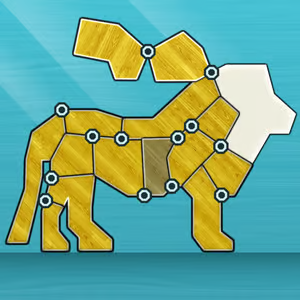
Shape Fold Animals expands on the successful formula of the original game by applying kinematic mechanics to biological forms. While the first game dealt with abstract geometry, this installment requires players to reconstruct recognizable creatures—llamas, rhinos, eagles, and more. This introduces a layer of semantic context to the gameplay. The puzzle is no longer just about "fitting shapes"; it is about reconstructing an anatomy. This shift makes the game highly intuitive yet complex, as organic shapes feature irregular curves and odd angles that differ from standard geometric grids.
The game serves as a bridge between art and logic. It requires the player to understand the articulation of joints—how a knee bends, how a wing folds against a body, and how a neck extends from a torso. It essentially gamifies the skeleton.
🧠 Cognitive Skills: Semantic Top-Down Processing
This iteration engages different neural pathways than abstract puzzles:
- Semantic Association (Top-Down Processing): Players use their real-world knowledge to solve the puzzle. "I see a long chain of pieces; that must be the elephant's trunk." This allows the brain to predict the solution before engaging with the mechanics.
- Visual Synthesis: The initial state of the level is a jumble of shards. The ability to look at this chaos and mentally synthesize the image of a "Turtle" is a strong test of visual closure skills.
- Fine Motor Precision: Animal silhouettes often have small, detailed extremities (ears, hooves, tail tips). Manipulating the mouse to fit these small polygons into tight spaces refines fine motor control.
🎮 Mechanics & Theme Specifics
The physics engine adapts to the organic theme:
- Joint Articulation: The hinges are placed anatomically. The pivot point for a leg piece is located where the hip would be. This makes the movement feel natural and grounded in reality.
- Asymmetrical Shapes: Unlike squares or triangles, the pieces here are irregular polygons. This makes "space packing" harder, as you cannot rely on 90-degree alignments. You must pay attention to the subtle curvature of the edges.
- Depth Layering (2.5D): Animals are 3D objects represented in 2D. The game simulates this by forcing layering. For example, the "back" leg of a horse must be folded down before the "front" leg to create the correct visual overlap.
🏆 Zoological Strategy Guide
1. Locate the Head and Spine
In almost every vertebrate puzzle, the spine is the central chain of linkages. Locate the head piece (usually easy to spot due to an eye or snout) and the chain attached to it. Aligning the spine with the silhouette splits the puzzle into manageable "upper" and "lower" halves.
2. The Extremities Last
Do not start with the feet or tail. These are the end-effectors of the kinematic chain. They are the most movable and unstable parts. Secure the heavy body mass first to create a stable frame, then fold the limbs in to match.
3. Visual Cues
Use the color and texture to your advantage. While the pieces are solid colors, they often share a palette. If a piece is a slightly darker shade, it might imply it belongs in the background (shadow) layer.
🛡️ Technical & Educational Safety
Ideal for classroom and home environments:
- Curriculum Alignment: Can be used in early education to discuss biology, anatomy, and shape recognition.
- Safety: Zero violence, no chat functions, and no data collection make it COPPA-compliant and safe for children.
❓ FAQ
Is it just mammals?
The game covers a wide taxonomy, including mammals, reptiles, birds, and aquatic life, offering a diverse visual experience.
Does it work on tablets?
Yes, the tactile "drag-and-fold" mechanic is actually superior on touchscreens compared to a mouse/trackpad.