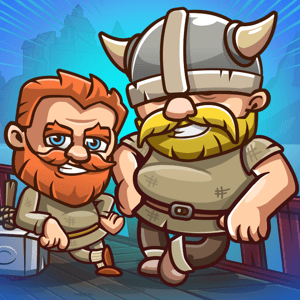
Duo Vikings
🛡️ Duo Vikings: The Mechanics of Symbiotic Cooperation
Duo Vikings establishes the foundational mechanics of the modern asymmetrical cooperative platformer. While playable solo (controlling both characters), the game shines as a test of communication and coordination between two players. The premise is deceptively simple: two Vikings must navigate a trap-filled castle. However, the level design forces a symbiotic relationship. Neither character can progress without the active physical support of the other.
In the 2026 educational gaming landscape, this title is cited for its implementation of "Stacking Physics." Unlike games where characters pass through each other, here they are solid rigid bodies. The core mechanic involves one Viking standing on the other's head to reach elevated platforms, or one Viking acting as a shield for the other. This physical interdependency creates a unique tactical layer.
🧠 Cognitive & Social Skills
Navigating the castle requires distinct mental operations:
- Role Flexibility: Players must constantly switch roles. In one room, Player A is the platform (bottom); in the next, they are the jumper (top). Adapting to these shifting hierarchies trains mental flexibility.
- Sequential Logic: Puzzles often involve "State Machines"—levers that open doors or move bridges. Players must decipher the correct order of operations. "I hold this lever so you can cross, then you hit that button so I can follow."
- Spatial Visualization: The castle is a maze. Players must visualize the path through obstacles, accounting for the movement limitations of their partner.
🎮 Mechanics & Physics Engine
The engine relies on specific interaction rules:
- The Head-Bounce: Jumping on your partner's head creates a higher bounce than a floor jump. This "Trampoline Effect" is essential for reaching secret areas and collectibles.
- Rigid Body Collision: You can push your partner. While this can be used for griefing, it is also a mechanic for solving puzzles—pushing a partner off a ledge to land on a switch below.
- Object Interaction: Both Vikings can interact with objects, but often their combined weight is needed to trigger pressure plates. Understanding mass summation is key.
🏆 Castle Strategy
1. The Moving Tower
The safest way to move is often as a stack (one carrying the other). This reduces the cognitive load of tracking two separate entities. Only separate when the puzzle geometry forces you to split up.
2. Momentum Transfer
When jumping across a gap, the top Viking should jump at the very apex of the bottom Viking's jump. This sums their velocity vectors, allowing for massive horizontal distance. It requires precise countdown timing (3... 2... 1... Jump).
🛡️ Technical Specifications
Optimized for local co-op:
- Input: Player 1 (WASD), Player 2 (Arrow Keys). The input buffer is generous to allow for slightly desynchronized jumps without failure.
- Visuals: Crisp 2D vector art ensures that interactive elements (levers, buttons) are visually distinct from the background.
❓ FAQ
Can I play alone?
Yes, you can switch control between Vikings or control them simultaneously, but it is a brain-twisting challenge.
Do the Vikings have different stats?
In the first game, they are functionally identical, focusing the difficulty on the environment rather than character builds.