World's Hardest Game 2
🟥 World's Hardest Game 2: Deterministic Chaos and Precision
World's Hardest Game 2 is the punishing sequel to the flash classic that defined the "rage game" genre. Unlike modern games that rely on RNG (randomness) or grinding, this title is built on deterministic logic. Every enemy moves in a fixed, mathematical cycle. If you stand in pixel (X,Y) at time T, the result will be identical every single time. This shifts the burden of failure entirely onto the player's execution, creating a gameplay loop of intense frustration and immense satisfaction.
In 2026, this game is studied as a benchmark for muscle memory consolidation. The only way to beat level 50 is to fail level 50 one hundred times, allowing your brain to internalize the enemy patterns until movement becomes subconscious reflex.
🧠 Cognitive & Motor Skills
Surviving the grid requires specific mental adaptations:
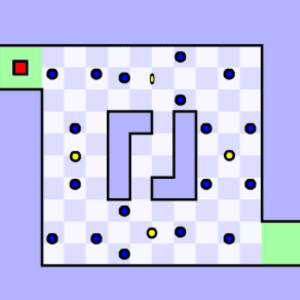
- Pattern Recognition: The blue dots (enemies) move in geometric patterns (windmills, grids, lines). Players must deconstruct these complex visual arrays into "safe zones" and "danger zones."
- Rhythmic Timing: The game is essentially a rhythm game without music. Gaps in the enemy defense open and close in a strict tempo. Aligning your movement with this hidden metronome is critical.
- Inhibition Control: The instinct is to rush to the checkpoint. The game punishes haste. Success requires the ability to stop instantly and wait for the precise millisecond to move.
🎮 Mechanics & Level Design
The engine is unforgiving by design:
- Hitbox Precision: The player (Red Square) and enemies (Blue Circles) have pixel-perfect hitboxes. There is no "coyote time" or leniency. Touching an enemy by a single pixel results in instant death.
- Checkpoint Logic: Green zones act as checkpoints. Advanced levels force the player to leave a checkpoint, collect a key (yellow dot), and return. This doubling back doubles the risk exposure time.
- Speed Variation: Unlike the first game, the sequel introduces enemies with variable speeds and more complex varying geometries, requiring faster on-the-fly calculations.
🏆 Survival Strategy
1. The "Safe Spot" Analysis
Don't look at the enemies; look at the empty space. In almost every spinning windmill pattern, there is a "blind spot" near the center that rotates with the blades. Identify this spot and move with it, rather than trying to outrun the blades.
2. Corner Cutting
Because your character is a square, your corners extend further than your sides. When navigating tight gaps, try to move cardinally (Up/Down/Left/Right). Moving diagonally effectively widens your hitbox profile relative to the obstacles, increasing the chance of a clip.
🛡️ Technical Specifications
Minimalist performance:
- Input Lag: Zero latency is mandatory. The game is optimized for keyboard polling to ensure every key press registers instantly.
- Visuals: High contrast (Red vs Blue on White grid) ensures maximum visibility, reducing eye strain during long attempts.
❓ FAQ
Is it actually the hardest?
It is hyperbolically named, but statistically, it has one of the highest quit rates of any browser game due to its difficulty curve.
How many levels?
There are 50 levels, significantly more than the original's 30, with a much steeper difficulty ramp.