Blob Drop
💧 Blob Drop: Analysis of Soft-Body Dynamics
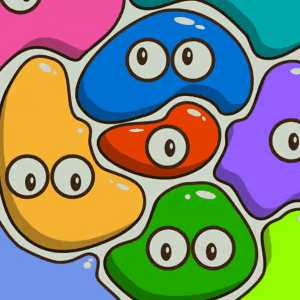
Blob Drop is a deceptively simple puzzle game that serves as a practical demonstration of soft-body physics simulations within a constrained space. Following the "Suika" (Watermelon) genre mechanics, the objective is to merge identical gelatinous entities to evolve them into larger forms. However, unlike rigid-body puzzles (like Tetris), these blobs deform, squish, and roll unpredictably based on momentum and elasticity.
For the analytical player, this game is a test of predictive modeling. You are not just placing an object; you are introducing kinetic energy into a closed system. The way a blob settles depends on the surface tension simulated by the engine and the angle of impact. It is an excellent tool for training the brain to anticipate non-linear physical outcomes.
🧬 The Evolution Algorithm
The core loop revolves around the Merge Chain. Understanding the hierarchy is crucial for high-score optimization:
- Mass Conservation: When two objects merge, the resulting object has a defined radius larger than the parents but often fits more efficiently due to the removal of air gaps.
- The Cascade Effect: A single drop can trigger a chain reaction. Advanced players look for "setups"—positioning smaller blobs underneath larger ones so that a future merge causes a gravity-assisted collapse, merging multiple layers simultaneously.
🧠 Cognitive Benefits & Strategy
1. Managing the "Dead Space"
The primary antagonist is not time, but geometry. Irregular shapes create gaps where smaller blobs get trapped. A key strategy is Agitation: dropping a heavy object forcefully to shake the container, utilizing the physics engine's collision jitter to settle the pile and close gaps.
2. Risk vs. Reward in Edge Play
Stacking blobs high near the walls is dangerous. The physics engine simulates friction; a round blob can easily roll off a stack and trigger the "Game Over" state if it crosses the upper threshold. Keep your structure pyramidal—wide at the base, narrow at the top.
🎮 Technical Performance
This title utilizes lightweight JavaScript physics libraries to ensure smooth rendering on mobile and desktop devices.
- Rendering: 2D Canvas with dynamic deformation meshes.
- Input Lag: Minimized for precise drop timing.
- Controls: Mouse or Touch to position horizontally; Release to drop.
❓ FAQ
What is the biggest blob?
The evolution chain typically ends at the "Giant" stage. Merging two Giants usually clears them from the board, rewarding a massive score bonus.
Why do blobs bounce?
The engine simulates elasticity (bounciness). Dropping from a greater height increases kinetic energy, causing a higher bounce upon impact.