Brain Test 3: Tricky Quests
🔮 Brain Test 3: The RPG-Puzzle Hybrid
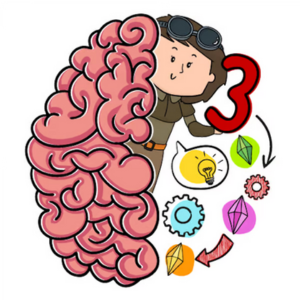
Brain Test 3: Tricky Quests redefines the boundaries of the logic puzzle genre by integrating Role-Playing Game (RPG) mechanics. While its predecessors focused on isolated vignettes, this title constructs a cohesive narrative journey following the protagonist, Alyx. It requires players to maintain a persistent mental state across levels, remembering plot points and carrying items from one scenario to the next.
The defining innovation here is the Inventory System. Unlike standard "spot the difference" or "trick logic" games, Brain Test 3 requires the player to collect, combine, and utilize objects. This moves the cognitive load from simple observation to associative problem solving. For example, finding a battery in Level 10 might be the key to powering a drone in Level 12.
🎒 Item Synthesis & Environmental Interaction
The puzzles act as a "Point-and-Click" adventure condensed into rapid-fire stages:
- Combinatorial Logic: You aren't just clicking; you are crafting. You might need to drag a "Hammer" icon onto a "Rock" icon to create "Gravel." This tests the brain's ability to visualize cause-and-effect relationships between abstract symbols.
- Multi-Stage Solutions: A single level often contains multiple layers. You must first distract a guard, then unlock a chest, then use the item found. This requires working memory retention, holding a sequence of operations in your head.
- Dialogue Clues: The NPCs (Non-Playable Characters) provide hints embedded in natural language. Players must parse the dialogue for semantic clues—if a character says they are "freezing," the solution inevitably involves fire or clothing found earlier.
🧙♀️ The Narrative Context
The game centers on collecting the "six power gems." This MacGuffin provides a structured goal, keeping players engaged through the Hero's Journey archetype. It moves the series from a "collection of jokes" to a "story of wit," increasing player retention through narrative hooks.
🎮 Accessibility Features
Recognizing the increased complexity, the game includes a robust "Help" system. Instead of simply skipping levels, the hint system is granular, offering progressive nudges (e.g., first hint: "Look at the inventory," second hint: "Combine the red and blue potions"). This scaffolding approach helps users learn the logic rather than bypassing it.
❓ FAQ
Do I need to play Brain Test 1 and 2 first?
No, the story is standalone. However, playing the earlier games helps train your brain to recognize the developer's logic style.
Where did my item go?
Some items are single-use. If you used the key to open a door, it is removed from your inventory to declutter the UI.