Four in a Row
🔴 Four in a Row: Applied Game Theory
Four in a Row (classically known as Connect 4) is more than a simple family pastime; it is a solved zero-sum game of perfect information. In the context of algorithmic study, this game is a primary example used to teach the Minimax algorithm to computer science students. For the player, it represents a rigorous test of spatial reasoning and forward planning (look-ahead). Unlike Chess, which has too many variables to solve completely, Four in a Row has been mathematically proven: the first player can always force a win if they play perfectly.
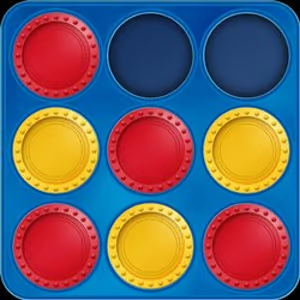
The game takes place on a 7x6 grid. The gravity mechanic—where tokens must fall to the lowest unoccupied slot—distinguishes it from Tic-Tac-Toe and Gomoku. This constraint limits the "search space" of possible moves, allowing players to calculate trap sequences (forks) several turns in advance.
🧠 The Central Column Hypothesis
Strategic analysis dictates that control of the center column (Column 4) is the single most critical factor in victory. Here is the mathematical breakdown:
- Connectivity Potential: A token in the center column can be part of 7 different winning lines (horizontal, vertical, and diagonal). A token in the side columns (1 or 7) can only be part of 3. Therefore, the center offers the highest probabilistic value per move.
- First Move Advantage: If you go first, taking the center slot effectively blocks the opponent's ability to create a vertical 4-stack in the most vital zone.
⚔️ Advanced Tactics: The Odd-Even Threat
High-level play revolves around the concept of "Parity." Because the grid has 6 rows, the game is finite. Players must manipulate the flow so that they place the final token in a specific row:
- The "7" Trap: Creating a setup where you have two potential winning spots that form the number "7". This forces a dilemma: if the opponent blocks one, you win with the other.
- Zugzwang: Creating a situation where the opponent is forced to make a move that ruins their position (e.g., placing a token that allows you to stack on top of it for a win).
🤖 AI Implementation
Our 2025 HTML5 version features an adjustable AI. On "Hard" mode, it utilizes alpha-beta pruning to anticipate your moves 6-8 turns ahead, simulating the pressure of playing against a grandmaster.
❓ FAQ
Is it always a win for Player 1?
Mathematically, yes. If Player 1 plays perfectly, they will always win. However, human error makes the game competitive.
What is a Fork?
A Fork is a scenario where you create two simultaneous threats to win. The opponent can only block one, guaranteeing your victory on the next turn.