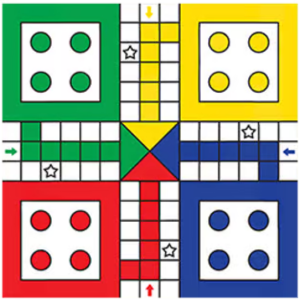
Ludo Multiplayer
🎲 Ludo Multiplayer: The Mathematics of Probability and Risk
Ludo Multiplayer brings the 6th-century Indian game of Pachisi into the modern browser era (2025-2026 standards). While often dismissed as a game of pure luck, Ludo is, at a competitive level, a complex exercise in probability management and risk assessment. This digital iteration removes the physical friction of dice rolling, allowing for rapid-fire matches that highlight the statistical nature of the gameplay.
The game serves as a social simulation, whether played against AI algorithms or human opponents. It tests the player's emotional discipline—specifically, the ability to mitigate the frustration of "bad RNG" (Random Number Generation) and stick to a statistically sound strategy regardless of short-term outcomes.
🧠 Cognitive & Social Dynamics
Beyond entertainment, Ludo engages specific analytical faculties:
- Probability Assessment: Every roll of the die changes the safety calculation. Players must intuitively understand that a token 6 spaces away from an opponent is in immediate danger (16.6% chance), whereas other distances have lower probabilities.
- Resource Allocation: You control four tokens. Deciding whether to move a single "scout" forward or advance all four in a phalanx is a resource management decision.
- Social Engineering: In multiplayer, targeting the leading player is a natural balancing mechanic. Understanding this social dynamic allows you to manipulate opponents into attacking each other.
🎮 Mechanics & Ruleset Analysis
This version implements the standard global ruleset with specific digital enhancements:
- The '6' Rule: Rolling a six is the catalyst. It not only unlocks a token from the yard but grants an extra turn. This creates "momentum swings" where a player can chain multiple moves, traversing half the board in a single turn.
- Safe Zones: The star-marked squares are sanctuaries. Tokens here cannot be captured. Controlling these chokepoints is critical for stalling the game while waiting for favorable dice rolls.
- Capture Physics: Landing on an opponent sends them back to the start. This is a massive tempo swing. The game engine highlights valid moves, allowing players to focus on the strategic choice of which token to move rather than counting squares.
🏆 Strategic Principles
1. The "Stacking" Fallacy
Some variations allow stacking tokens to form a blockade. However, in standard Ludo, spreading your tokens creates a "safety net." If one is captured, the others preserve your board presence. Do not put all your eggs in one basket unless a specific rule variant allows for invulnerable stacks.
2. The 7-Square Buffer
Statistically, the most common dice roll sum with two dice is 7, but Ludo uses one die. However, players often fear the "1" or "6". Keep your tokens at distances that are statistically harder to hit (like 1 or 3) relative to opponents chasing you, rather than the high-probability mid-range numbers.
🛡️ Technical Specifications
Built for seamless connectivity:
- Network: Utilizes WebSockets for real-time multiplayer with minimal latency, ensuring dice rolls are synchronized instantly across clients.
- Cross-Platform: Responsive design adapts the board layout for vertical mobile screens or horizontal desktop monitors.
❓ FAQ
Is the dice roll truly random?
Yes, the game uses a cryptographically secure pseudo-random number generator (CSPRNG) to ensure fair play.
Can I play offline?
Yes, the "Vs Computer" mode runs entirely client-side and requires no internet connection.