Solitaire
🃏 Solitaire: The Quintessential Sorting Algorithm Game
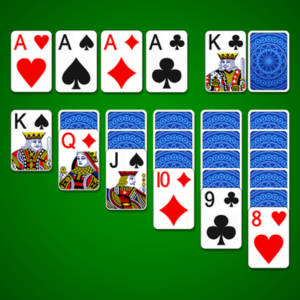
Solitaire (specifically the Klondike variation) is arguably the most played computer game in history. At its core, it is a gamified sorting algorithm. The objective is to organize a disordered dataset (a shuffled deck) into four ordered stacks (foundations) based on specific rules of sequence and color. In 2026, it remains the gold standard for casual logic puzzles, requiring a mix of probabilistic planning and risk management.
Unlike many modern games that rely on dopamine-heavy visuals, Solitaire relies on the satisfaction of bringing order to chaos. It is a test of patience and foresight, often used as a cognitive benchmark for executive function. The game teaches that not every problem has a solution, as some shuffles are mathematically unsolvable.
🧠 Cognitive Load: Executive Function
Solitaire is a rigorous workout for the frontal lobe:
- Working Memory: You must remember which cards are hidden under which stacks. "I need a Red 9. I saw a Red 9 in column 4 five moves ago." Retaining this state information is key to efficiency.
- Look-Ahead Capability: Novices make the first move they see. Experts look 3 moves ahead. "If I move this 7, I free up a King, but I block the Black 6." Weighing these consequences is critical strategic thinking.
- Inhibition: Just because you can move a card doesn't mean you should. Holding back a move to keep a lane open for a King is a strategic decision that requires impulse control.
🎮 Mechanics & Ruleset
This HTML5 version adheres to the strict Klondike rules:
- Tableau Building: You build downwards in alternating colors (Red on Black, Black on Red). This constraint forces you to manage your available "sockets" for cards.
- Stockpile Management: You can draw 1 or 3 cards (configurable). Draw-3 mode significantly increases the difficulty and requires deeper buffer management, as you can only access every third card.
- Entropy: Not every shuffle is solvable. The game uses a randomization engine. Recognizing when a game is statistically unwinnable and restarting is part of the skill curve.
🏆 Master Class Strategy
1. Unlock the Face-Down Cards
Your primary goal is not to build the foundations (Ace piles); it is to turn over the face-down cards in the tableau. These hidden cards represent unknown variables. Prioritize moves that flip a face-down card over moves that just tidy up the board.
2. Empty Column Management
Do not empty a tableau column unless you have a King ready to fill it. An empty column is a powerful resource, but only if utilized. Leaving it empty creates a "dead zone" where no sorting can occur.
3. Foundation Delay
Don't rush to put cards into the Foundation piles (Aces/Twos). Sometimes you need that Red 5 in the tableau to hold a Black 4. Once a card is in the Foundation, it is (usually) harder to retrieve.
🛡️ Technical Specs
Refined for 2026 browsers:
- Undo Function: Unlimited undo allows for learning from mistakes without punishment.
- Auto-Complete: Smart detection automatically finishes the game when the mathematical solution is guaranteed.
❓ FAQ
Is every game winnable?
No. In Draw-3 Solitaire, only about 79% of games are theoretically winnable, and even fewer are winnable by human players.
What is the difference between Draw 1 and Draw 3?
Draw 1 is easier because you see every card in the deck linearly. Draw 3 hides cards, requiring you to manage the "buffer" of the waste pile.